
Cryptocurrencies and DeFi in 2026: How mindfulness and crypto change the human mind

Updated: Jul 17
From Bitcoin to DeFi: The New Era of Investing, Market Psychology, and How Mindfulness Helps Crypto Investors Stay in Control
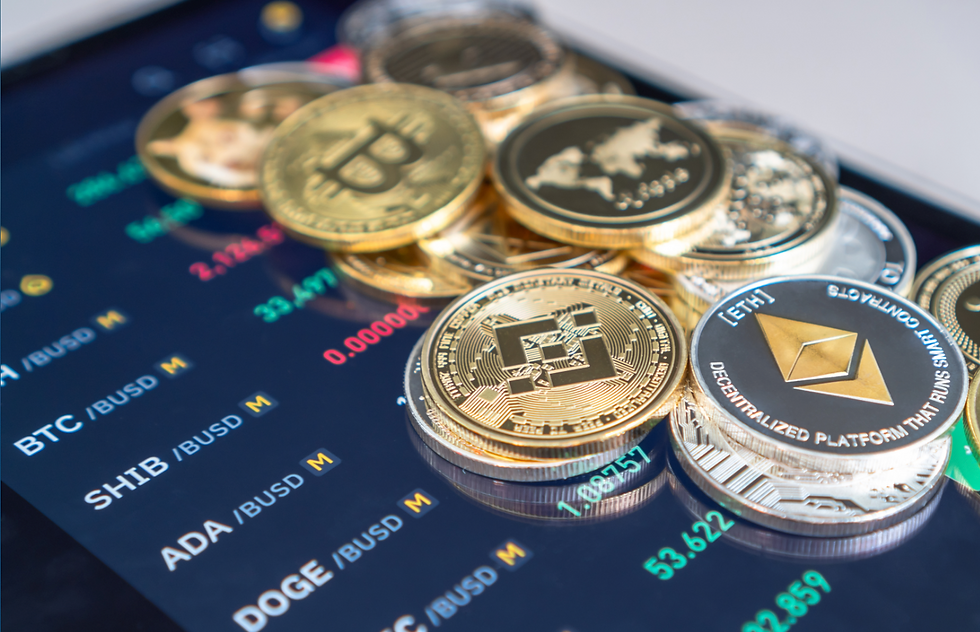
Imagine a world without banks, without waiting, without approvals, just you and your money. As utopian as it may sound, this is no longer a theory. It’s a reality already unfolding. Cryptocurrencies and decentralized finance are slowly but steadily building a parallel financial system that doesn’t ask for permission and doesn’t recognize borders.
Major institutions are already stepping into the game, billions of dollars are flowing onto blockchain networks, and what looked like an experiment yesterday is becoming the infrastructure of tomorrow.
But behind this story, there’s more than just technology. There’s something deeper, a shift in how people think about money, risk, and control over their own lives. And this is where mindfulness psychology enters the picture, turning this story into something far more compelling.
What Are Cryptocurrencies, Blockchain, and DeFi?
Cryptocurrencies are a digital form of money that exists only online, with no physical equivalent. What makes them fundamentally different from traditional fiat currencies is that they are not controlled by any bank, government, or centralized authority. Cryptocurrency can be sent and received directly, without intermediaries.
They operate on a technology called blockchain, which can be described in simple terms as a public, decentralized database, a digital ledger that anyone can view, but no one can alter retroactively.
DeFi, or decentralized finance, represents the next step in the evolution of cryptocurrencies. It is not money itself, but an entire financial system built on blockchain and digital assets.
Instead of banks, DeFi relies on applications that enable lending, investing, trading, and saving, all executed automatically through smart contracts, without intermediaries.
How Cryptocurrencies Began and Who Created Them
The story of cryptocurrencies began in 2008, when an anonymous individual or group under the pseudonym Satoshi Nakamoto introduced the idea of a digital monetary system independent of banks.
In 2009, the first and most important cryptocurrency, Bitcoin, was launched. Its purpose was simple: to enable the transfer of money without intermediaries, offering freedom and independence from centralized systems like banks and governments.
Shortly after Bitcoin’s initial success, Vitalik Buterin introduced the second major cryptocurrency, Ethereum, launched in 2015. Ethereum marked a turning point in the crypto space. Unlike Bitcoin, it introduced smart contracts, or programmable money. This allowed developers to build applications on blockchain networks, not just transfer value. It was a crucial step in the rise of DeFi.
The real explosion, often referred to as the DeFi boom, occurred around 2020. During this period, decentralized exchanges, lending platforms, yield farming, and an entirely new financial ecosystem emerged, operating 24/7 without central control.
Over time, the crypto market has matured. Institutional investors have entered the space, stablecoins have gained traction, real-world assets are being tokenized, and regulatory frameworks are slowly taking shape. DeFi is no longer seen as an experiment, but as a serious alternative to traditional finance, although it still carries risks such as hacks, bugs, and volatility.

Cryptocurrencies and Mindfulness Psychology
Cryptocurrencies and DeFi originally emerged from a group of enthusiasts driven by distrust in centralized systems and the belief that financial control should return to individuals. But the game has changed.
This is no longer a niche movement. Institutional capital, from corporations, banks, and governments, is entering the space, and regulation is gradually forming. Crypto and DeFi are evolving into a parallel financial system that is slowly integrating with traditional banking.
The crypto market is notoriously brutal and defined by extreme volatility. This isn’t a temporary phase; it’s a constant. Investors have had to go through multiple boom-and-bust cycles to understand that volatility is part of the system. And this is where the connection to mindfulness becomes especially interesting.
Research suggests that due to high risk, emotional stress, and reward-driven behavior, cryptocurrency trading often mirrors the psychological patterns seen in gambling.
People enter the market seeking profit, but many stay because of dopamine. That’s where problems begin, like impulsive decisions, FOMO (fear of missing out), and panic during downturns.
Add to that common cognitive biases such as herd behavior, overconfidence, and loss aversion, the tendency to feel losses more intensely than gains, and you get a perfect storm of emotional chaos.
This is where mindfulness comes into play.
Mindfulness, in simple terms, is the ability to observe your thoughts and emotions without automatically reacting to them. In the context of crypto, it’s the difference between panic selling and making a rational decision. It’s the difference between reacting impulsively and observing analytically.

The most successful crypto investors today are increasingly thinking long-term and acting with awareness. The game is no longer about quick flips. It’s about discipline, risk management, and mental stability. In other words, the mindset of crypto investors is shifting, from gambling to strategy.
Mindfulness is becoming a practical tool. If you control your emotions, you avoid FOMO. If you understand your reaction to losses, you won’t panic sell. And if you recognize the pull of hype, you’re more likely to stay rational while others lose control.
The connection between crypto and mindfulness doesn’t stop at the individual level; it’s beginning to appear at the level of nations and economic models.
For example, the Gelephu Mindfulness City project in Bhutan aims to combine sustainable economic development, mindfulness philosophy, and cryptocurrencies. The country has even explored using Bitcoin as part of its long-term development and financing strategy. It’s a real-world example of where spiritual philosophy and digital money intersect.
Conclusion
Times are changing. Technology is changing. People are changing. And so is the way we think.
Ideas like mindfulness, once dismissed as a passing trend or “new age nonsense,” are now gaining serious traction, even among cryptocurrency investors.
The intersection of cryptocurrencies, DeFi, and mindfulness reveals a deeper truth about modern finance: technology alone is not enough. Decentralized systems promise freedom, transparency, and control over money, but the real challenge remains human psychology. The crypto market is highly emotional, driven by fear and greed, where investors often make impulsive decisions instead of rational ones.
That’s where mindfulness proves its real value, as a tool that creates distance between emotion and decision.
In a world where markets never sleep and decisions are made in seconds, the ability to think calmly and clearly becomes a true competitive advantage.
The future of finance may be decentralized, but success within that future will remain deeply personal and will depend on how well we manage ourselves.


Reading this, I found myself reflecting on something deeper than technology or finance.
What becomes clear is that crypto and DeFi are not just external systems we interact with, they are environments that begin to mirror and amplify our inner state. The speed, the volatility, the constant flow of information… it all pulls on the same psychological patterns: anticipation, fear, attachment, identity.
And that raises a confronting question:are we actually prepared, internally, for the level of autonomy we are building externally?
Because as control decentralizes, responsibility recenters. Not in institutions, but in the individual mind.
What resonates strongly in your conclusion is the idea that mindfulness is not a luxury alongside this evolution, it is a necessity within it. Without…
Feel free to comment!