
Online Tribes: How Digital Communities Shape Identity, Opinions, and the Future of the Internet

Updated: Aug 14
From social media algorithms and echo chambers to digital identities and AI-driven communities, exploring why online tribes have become one of the most powerful forces shaping modern society.
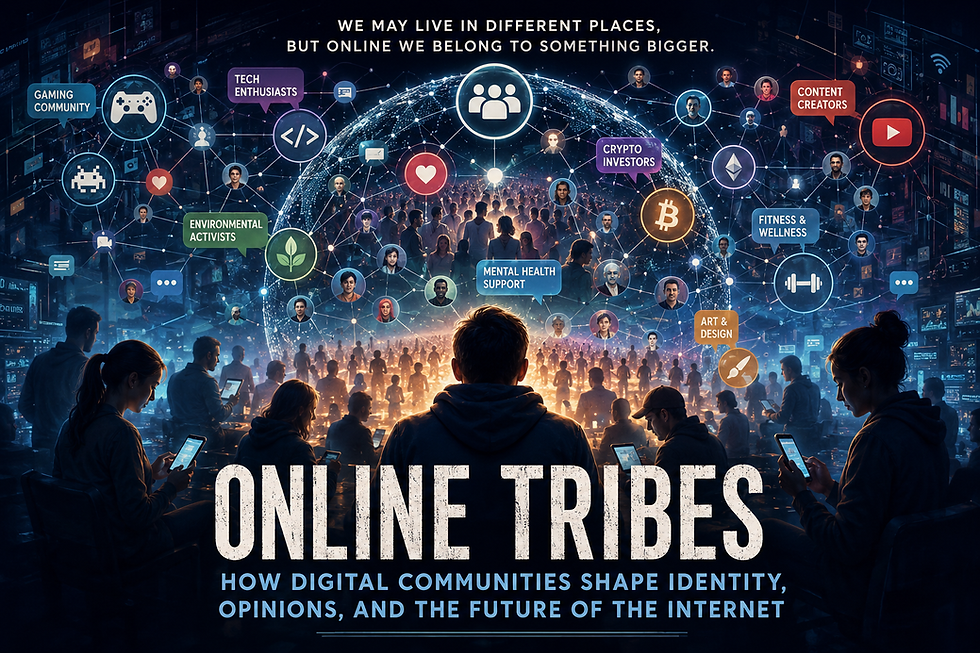
Since the earliest days of human civilization, people have felt an innate need to gather in communities. The family has always been humanity's most fundamental social unit. As multiple families joined together for shared purposes such as hunting, defense, warfare, or survival, tribes emerged.
Today, in the modern world, people still seek out groups that share similar values, beliefs, and interests. The difference is that these gatherings now take place digitally, across the internet. These virtual connections have given rise to what we now call online tribes.
When the internet first appeared, many believed that digital technology would unite millions of people from different cultures into one vast global community, a place where knowledge would be freely available to everyone, and communication would be open, democratic, and unrestricted.
Today, however, it has become clear that this vision has not fully materialized. Instead, something remarkably similar, but fundamentally different, has emerged. Rather than one enormous global digital community, thousands of smaller communities have formed, each functioning like a modern-day tribe.
Every one of these digital tribes has its own rules, symbols, values, communication style, hierarchy, and sense of belonging, making it unique and distinct from the others.
Online Tribe or Digital Tribe?
The terms "online tribe" and "digital tribe" are far more than simple metaphors. Over the past decade, they have increasingly been used by sociologists, psychologists, anthropologists, and digital media experts to describe groups of people who gather around shared interests, beliefs, hobbies, political views, or identities.
What distinguishes these communities from traditional social groups is that physical distance has become almost irrelevant. Members may live on different continents, speak different languages, and never meet face-to-face, yet still develop a remarkably strong sense of connection.
That feeling of belonging is the foundation of every online tribe. People come to find "their people", individuals who share their interests, understand their struggles, or validate their perspectives. Psychologists generally agree that this reflects one of humanity's oldest instincts: the need to belong to a group. The internet did not create that instinct; it simply gave it an entirely new environment in which to flourish.

The Birth of Online Tribes and Their Evolution
The first digital communities appeared long before Facebook, Instagram, or TikTok existed. During the 1980s, Bulletin Board Systems (BBS), online forums, and Usenet groups allowed people to discuss technology, science, music, and computer games.
Communication was slow, entirely text-based, and technically demanding by today's standards.
Yet even then, nearly all the defining characteristics of today's online communities were already visible. There were respected members, unwritten rules of conduct, inside jokes, and even conflicts between rival groups.
With the rise of social media in the early 21st century, the number of digital communities exploded. Facebook Groups, Reddit communities, Discord servers, Twitch channels, Telegram groups, and countless other platforms made it possible to build micro-communities around almost any topic imaginable.
Today, there is a community for nearly every interest, from astronomy and gardening to cryptocurrencies, artificial intelligence, extreme sports, and collecting.
One of the most fascinating developments today is that modern online tribes no longer emerge entirely on their own. Increasingly, they are shaped by algorithms. Social media platforms and many other online services collect vast amounts of user data, analyzing every click, like, comment, and interaction.
Based on this information, algorithms recommend new content and introduce users to communities that align with their interests and behavior. Gradually, people find themselves surrounded by others who think as they do.
Another striking feature of today's online tribes is that they have developed many of the characteristics traditionally associated with tribal societies. They create their own language, inside jokes, symbols, memes, abbreviations, and expressions that outsiders often struggle to understand.
In recent years, linguists have drawn attention to the phenomenon known as "algospeak", language that users deliberately adapt to social media algorithms in order to avoid automated moderation or improve the visibility of their content. As a result, algorithms are influencing not only what we see online but also the way we communicate.
Every online tribe also develops its own informal leaders, modern-day tribal chiefs, if you will. These are not necessarily the people with the largest number of followers, but rather those whose opinions carry the greatest credibility within the community. In some groups, they are recognized experts, in others, administrators or moderators, while elsewhere they may be influential content creators.
Their influence frequently extends well beyond the platforms where they built their audiences, shaping the opinions of thousands, or even millions, of people.

Why Do People Form Online Tribes?
Why do people gather in digital communities in the first place?
At first glance, the answer seems obvious. We might simply say that people come together because they share common interests. In reality, however, the picture is far more complex. People are drawn not only by the content itself but, above all, by a sense of belonging. The need to be part of a group is one of the oldest and most deeply rooted human instincts.
The digital world has made something possible that would have been unimaginable throughout most of human history. Someone living in a small rural town can now communicate every day with thousands of people who share the same hobby, political beliefs, health challenges, or philosophy of life.
Borders have become less significant, and geography has lost much of its former power. Instead of being built around neighborhoods or cities, communities are now formed around shared interests, identities, and values.
One of the most fascinating aspects of this transformation is the role online communities play in reinforcing personal identity. People naturally seek out information that confirms their existing beliefs, values, and opinions. Psychologists refer to this tendency as confirmation bias. When we find a community that thinks the way we do, our beliefs feel validated, and our sense of identity grows stronger.
The internet accelerates this process dramatically by allowing us to connect almost instantly with thousands of like-minded people from every corner of the world.
Yet the very same psychological need that helps build strong communities can also create closed information ecosystems. When most members of a group share the same beliefs, opposing viewpoints are often perceived as threats to the group's identity.
This is where the phenomenon known as the echo chamber begins to emerge. Within these environments, people are exposed to fewer alternative perspectives, while their existing beliefs become increasingly reinforced.
Emotions also play a crucial role. Until fairly recently, it was widely assumed that algorithms primarily analyzed users' interests. More recent research, however, suggests that digital platforms have become remarkably effective at recognizing emotional responses as well.
Content that evokes powerful emotions, such as anger, excitement, fear, outrage, hope, or surprise, typically generates far greater engagement than neutral or emotionally restrained posts. As a result, emotionally charged topics are far more successful at attracting and sustaining online communities than content that provokes little emotional reaction. In many ways, emotions have become the glue that holds digital tribes together.
Membership in an online tribe is expressed through far more than discussions or shared emotions. It is also reflected in inside jokes, memes, distinctive writing styles, specialized vocabulary, and cultural references understood only by members of a particular community.
Anthropologists have long observed that traditional tribes used rituals, clothing, symbols, and customs to distinguish insiders from outsiders. Online, those same social functions are often performed by avatars, hashtags, emojis, memes, profile images, and even recognizable communication styles.
One person can easily belong to several online tribes at the same time. They might discuss business on LinkedIn in the morning, share family photos on Facebook during the afternoon, and post opinions on X later that evening.
Sociologists describe this phenomenon as multiple digital identities.
The internet allows people to participate simultaneously in many entirely different communities. That is why modern individuals rarely belong to just one "tribe." Instead, they become part of an interconnected network of digital affiliations that overlap and evolve alongside one another.

The Future of Online Tribes: Will Digital Communities Become More Important Than Real-World Ones?
The answer is anything but straightforward. However, growing evidence suggests that online tribes are no longer merely an extension of everyday life; they are gradually becoming one of its defining foundations.
The changes are visible almost everywhere. Today, people use the internet to find friends, business partners, romantic relationships, doctors, mentors, investors, and even emotional support. For younger generations, especially, the internet is no longer a separate virtual space but a natural extension of everyday life.
The distinction between online and offline identity continues to blur as social media platforms, forums, and messaging apps increasingly shape how people think, make decisions, and build relationships.
One of the clearest trends is the ongoing fragmentation of the internet. A decade ago, large public social media platforms dominated online interaction. Today, however, many users are moving away from massive public networks and toward smaller, specialized communities.
Rather than sharing their thoughts with thousands of strangers, they increasingly prefer private groups where trust, familiarity, and meaningful conversation are easier to maintain. Research consistently indicates that users value authenticity, privacy, and high-quality interactions more than ever before, even if that means participating in communities with fewer members.
At the same time, artificial intelligence is beginning to play an increasingly important role in the evolution of online communities. AI is no longer limited to recommending content. It is now widely used to moderate discussions, detect hate speech, suggest new community members, translate conversations between different languages, and assist administrators in managing large groups.
Future digital communities will likely be shaped through collaboration between people and intelligent systems, raising important questions about transparency, accountability, and the growing influence algorithms may have over social relationships.
Alongside this trend, the idea of decentralized digital communities continues to gain momentum. Rather than allowing a handful of major technology companies to dictate the rules of online communication, an increasing number of researchers and technology experts advocate for open protocols, greater user control over personal data, and governance models in which communities establish and enforce their own rules. These approaches aim to reduce dependence on large platforms while giving users greater autonomy over the digital spaces they inhabit.
Conclusion
Today's digital communities shape the way we learn, build friendships, shop for products, consume news, develop political opinions, and construct our personal identities. They can be powerful sources of support, creativity, collaboration, and innovation, but they can also become environments where prejudice is reinforced, misinformation spreads, and social divisions deepen. That is why understanding online tribes is no longer a topic reserved for sociologists or technology experts. It has become an issue that affects every one of us.
As artificial intelligence continues to reshape the digital world, online tribes will almost certainly become more sophisticated, more interconnected, and more influential.
Yet regardless of how far technology advances, one truth is unlikely to change: at the heart of every digital community remains a human being with the timeless desire to belong, to be understood, and to be part of something greater than themselves.
Technology can connect millions of people with a single click. Still, the true value of any community will always depend on trust, empathy, and the willingness to build genuine human relationships. Ultimately, the balance between technological progress and these fundamental human values will determine whether online tribes become a driving force for a more open, collaborative society or whether they deepen the divisions that already exist.



Feel free to comment! 😀