
Mindfulness and the Market: Why the Most Rational Investors First Learn to Watch Their Own Minds

The Myth of the Rational Investor
Financial markets are often portrayed as arenas of cold rationality. They are imagined as spaces where prices reflect information, and disciplined investors make calculated decisions. Yet decades of researc
h in behavioural finance suggest a more complicated reality. Investors, like all of us, are prone to emotion, cognitive shortcuts, and subtle psychological distortions. Some of the most persistent market anomalies ranging from speculative bubbles to panic-driven sell-offs, cannot be understood through economic fundamentals alone, but also through the collective psychology of decision-makers.
This creates a paradox. Modern finance relies heavily on models that assume rational behaviour, yet the success of many investors depends in part on managing the irrational tendencies of their own minds.
In recent years, a concept more commonly associated with meditation or spirituality has entered this conversation: mindfulness. Far from being merely a wellness trend, mindfulness (defined broadly as sustained, non-judgmental attention to present experience) may offer one way to reduce reactivity, improve emotional regulation, and make psychological biases easier to notice in real time.
The deeper question, however, is not simply whether mindfulness makes investors calmer. It is whether greater awareness of one’s own mental processes can meaningfully change how risk is assessed, decisions are made, and capital is allocated in modern markets.
"The investor's chief problem, and even his worst enemy, is likely to be himself." — Benjamin Graham, The Intelligent Investor [1]
The Hidden Architecture of Financial Bias
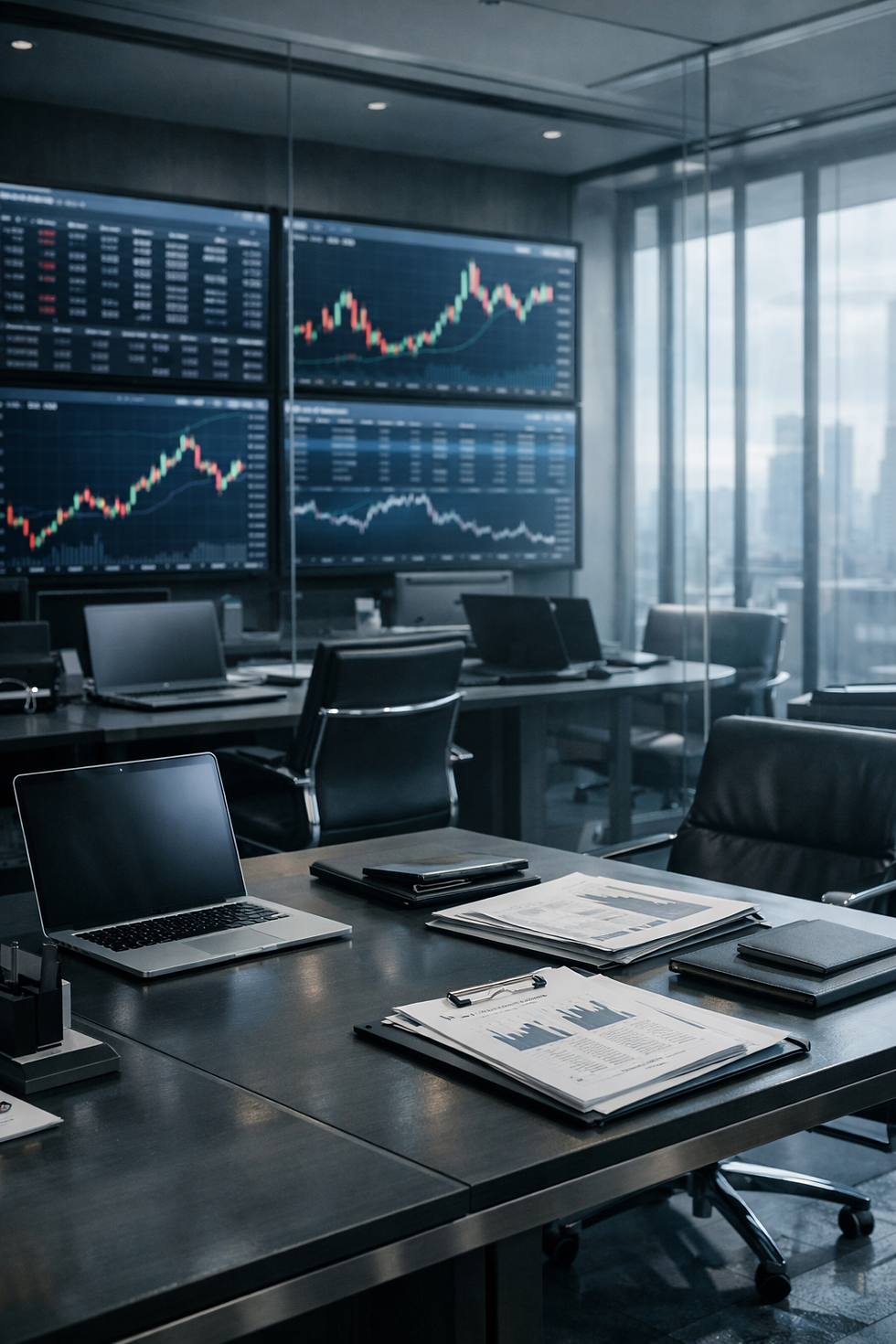
Financial markets may appear quantitative, but the decision-making behind them often follows recognizably emotional patterns. Over the past four decades, behavioural finance has documented the ways psychological biases shape investment behaviour. One of the field’s most influential foundations came from psychologists Daniel Kahneman and Amos Tversky, whose work on heuristics and biases showed that people rely on mental shortcuts when making decisions under uncertainty. These shortcuts can be useful, but they also lead to systematic errors.
In investing, two biases appear repeatedly.
Overconfidence bias
This bias leads individuals to overestimate their knowledge, judgment, or predictive ability. Research has shown that overconfident investors tend to trade more frequently, often reducing their returns through transaction costs and poor timing. Work by researchers at the University of California, Berkeley found that highly active retail investors historically underperformed the market by a meaningful margin. [2]
Loss Aversion
Loss aversion is a concept central to prospect theory. Kahneman and Tversky showed that losses tend to weigh more heavily on people than comparable gains. As a result, investors often hold losing assets too long in the hope of recovery, while selling winning positions too early.
These tendencies can become especially pronounced during periods of uncertainty. During the Global Financial Crisis, for example, panic selling followed years of exuberance and inflated expectations. In both directions, market behaviour often reflected not only changing fundamentals, but also powerful emotional and psychological dynamics.
Mindfulness, in this context, does not eliminate bias. Its possible value lies elsewhere: in making automatic patterns easier to detect before they are acted upon. Recognising an emotional impulse before turning it into a financial decision may give investors a chance to pause, reassess the evidence, and avoid reactions that undermine long-term judgment.
Emotion, Stress, and the Physiology of Investing
Financial decisions are often framed as a purely cognitive process, but research in neuroscience and neuroeconomics suggests they are also deeply emotional and physiological experiences.
Studies of risk and uncertainty indicate that financial decision-making engages brain systems involved in fear, reward, and threat detection. When investors face uncertainty or the possibility of loss, emotional and physiological responses can begin shaping behaviour before deliberate reasoning has fully caught up. [3] [4]
Research in affective neuroscience suggests that emotional arousal can alter risk preferences, although the direction of that effect depends on context. In some cases, stress or fear can make people more cautious; in others, excitement or reward anticipation can encourage greater risk-taking. In practice, this means that investors under pressure may depart from their stated strategy not because the facts have changed, but because the situation simply feels different.
Hormones appear to play a role as well. Field research on traders has found that cortisol, the body’s primary stress hormone, tends to rise during periods of heightened uncertainty. Later experimental research suggested that sustained elevations in cortisol can make financial decision-makers more risk-averse. Other work has linked elevated testosterone during winning streaks with increased confidence and, at times, greater risk-taking. [5] [6]
These biological responses can contribute to cycles of boom and bust. In rising markets, optimism and reward signals may encourage increasingly aggressive behaviour. In downturns, fear and stress can trigger rapid withdrawals, defensive positioning, and self-reinforcing sell-offs.
Mindfulness practices and particularly those involving attentional training and focused breathing, have been associated in some studies with reduced stress reactivity and improved emotional regulation. The evidence is not uniform, and effects vary across populations and study designs, but the broader pattern suggests that mindfulness may help people respond less automatically under pressure. [7]
In financial contexts, that possibility matters. If awareness practices help investors maintain greater clarity in stressful environments, they may support better judgment in situations designed to provoke emotional reaction.
Mindful Risk: Slowing Down the Decision Loop
One of the defining features of modern markets is speed. Algorithmic systems execute transactions in milliseconds, and financial news circulates globally in seconds.
Human decision-making, however, evolved for a much slower environment.
Psychologist Daniel Kahneman famously described two modes of thinking:
System 1, which is fast, intuitive, and automatic
System 2, which is slower, deliberate, and analytical.
Financial decisions often begin with System 1 reactions - rapid judgments formed under incomplete information and shaped by prior emotion, habit, or narrative.
Mindfulness can be understood as one way of interrupting that rapid decision loop.
By training attention and awareness, individuals may become more capable of noticing when intuition, anxiety, excitement, or ego is driving behaviour. That pause creates space for more deliberate evaluation: not the removal of intuition, but the chance to examine whether a reaction is proportionate, evidence-based, and consistent with a longer-term plan.
The idea resembles practices used in other high-stakes professions. Pilots, surgeons, and military commanders rely on checklists, protocols, and deliberate pauses to reduce the likelihood of error under stress or cognitive overload.
In finance, the equivalent may involve structured reflection before action: reviewing assumptions, identifying emotional triggers, and considering longer-term consequences before executing a trade or reallocating capital.
Historical examples underscore the value of such restraint. Long-term investors such as Warren Buffett have repeatedly emphasized patience, selectivity, and emotional discipline as central elements of successful investing. Buffett’s approach has often involved holding assets for years or decades rather than reacting to short-term fluctuations. [7]
Mindful risk assessment, then, does not necessarily create more cautious investors. It may instead create more intentional ones: people better able to distinguish between genuine opportunity and emotionally driven speculation.
Speculation, Time Horizons, and the Attention Economy
Another dimension of mindful finance concerns time horizon.
Short-term speculation has always existed in markets, but technological change has intensified it. Mobile trading platforms, real-time price feeds, and social media have created an environment in which attention is constantly pulled toward what is immediate, visible, and emotionally charged. [8]
During the speculative surge surrounding Bitcoin and other digital assets in the late 2010s and early 2020s, millions of new investors entered markets drawn by narratives of rapid wealth creation. Online communities amplified enthusiasm, while viral stories of sudden profits encouraged increasingly risky behaviour.
Behavioural economists have described related dynamics as forms of attention-driven investing. Assets that receive disproportionate media coverage often attract investor flows not simply because they are fundamentally attractive, but because they are salient, discussed, and difficult to ignore.
Mindfulness pushes against that logic by redirecting attention away from noise and toward deliberate evaluation. Instead of reacting to headlines or market mood, mindful investors may be more likely to ask slower questions:
What assumptions justify this valuation?
What is the long-term trajectory of this asset?
Am I responding to information, or to excitement?
This shift in attention echoes older principles in investment philosophy. Graham and Buffett both emphasized the importance of separating market price from underlying value.
In a digital environment saturated with signals, commentary, and emotional contagion, the ability to withdraw attention from noise may itself become a competitive advantage.
Ethical Awareness and the Allocation of Capital

The final dimension of mindfulness in finance extends beyond individual decision-making to broader ethical awareness.
Every investment represents, at least implicitly, a choice about how resources are distributed within society. Capital can support technological innovation, infrastructure, and productive enterprise, but it can also reinforce environmental damage, political instability, extractive behaviour, or speculative excess.
Over the past decade, interest in environmental, social, and governance (ESG) investing has grown substantially. Reports from institutions such as Morningstar, Bloomberg, and the Global Sustainable Investment Alliance suggest that global sustainable-investment assets exceeded $30 trillion in the early 2020s, reflecting rising demand from investors who want some alignment between financial returns and ethical considerations. [9]
Mindfulness may deepen this conversation by encouraging reflection not only on profitability, but also on consequence.
In Buddhist philosophy, where many contemporary mindfulness practices have roots, economic activity is often discussed through the idea of “right livelihood,” the principle that wealth creation should avoid causing harm. Modern finance operates within very different institutional and moral frameworks, but the underlying question remains relevant: what kinds of outcomes are investors helping to fund? [10]
Critics argue, often with justification, that ethical investing can become symbolic rather than substantive, with firms rebranding themselves without changing much in practice. Yet even these criticisms reflect a broader shift. Investors are no longer asking only whether a strategy performs, but also what it supports, legitimizes, or externalizes. [11]
If mindfulness encourages greater awareness of motive and consequence, it may gradually influence not only how investors make decisions, but how they understand the responsibilities attached to capital allocation.


Very nice, Aleksandar!
Being a little bit of a crypto trader myself, I have a good understanding of where this article is going. I have tried almost everything from Scalping trading, Bot trading, to calm HODL-ing, and my opinion is that calm head and steady nerves go a long way in any kind of trading, but especially in Crypto!
Regards!