
Food Under Pressure: How Climate Change Is Reshaping Global Nutrition

The future of nutrition will not be determined only by what humanity chooses to eat, but increasingly by what the planet remains capable of producing.
Climate Change and the Availability of Healthy Food
Food is often discussed as a matter of agriculture, household consumption, public health, or economic development. Climate change demonstrates that these domains can no longer be treated separately. Rising temperatures, changing precipitation patterns, droughts, floods, wildfires, soil degradation, and disruptions to marine ecosystems are altering the conditions under which food is produced, distributed, and consumed. The consequence is not simply a question of whether enough calories will remain available. Increasingly, the central question is whether populations will have reliable access to nutritious, diverse, safe, and affordable food.

The 2026 Global Nutrition Report places this challenge within a broader systems perspective, emphasizing that climate change is simultaneously putting pressure on food systems and health systems. The report highlights the need for greater integration between food, health, climate, governance, financing, and data systems to improve access to healthy diets. Meanwhile, the 2026 Global Report on Food Crises, produced through the Food and Agriculture Organization of the United Nations (FAO), the World Food Programme (WFP), and the Global Network Against Food Crises (GNAFC), demonstrates that acute food insecurity and undernutrition remain major global challenges.
The Intergovernmental Panel on Climate Change (IPCC) has similarly established that climate-related hazards increasingly affect food production, livelihoods, ecosystems, and human health. These effects are particularly severe for populations that already face poverty, weak infrastructure, political instability, or limited access to healthcare. Climate change therefore does not create vulnerability uniformly; it amplifies existing inequalities within food and health systems.
Drought, Heat, Floods, and the Disruption of Food Production
Climate change affects food production through multiple and interconnected mechanisms. Drought reduces water availability, weakens agricultural productivity, damages soils, and places additional pressure on livestock systems.Extreme heat can interfere with crop development, reduce yields, increase livestock stress, and intensify agricultural water requirements. Flooding creates another set of challenges by destroying crops, eroding agricultural land, contaminating water supplies, and damaging transportation and storage infrastructure.
According to the IPCC, climate-related extremes have already affected agricultural, forestry, and fishery productivity. Extreme weather events can reduce food availability while simultaneously increasing prices. Marine heatwaves can also disrupt fisheries and aquaculture, threatening both food supplies and the livelihoods of communities dependent upon aquatic resources.
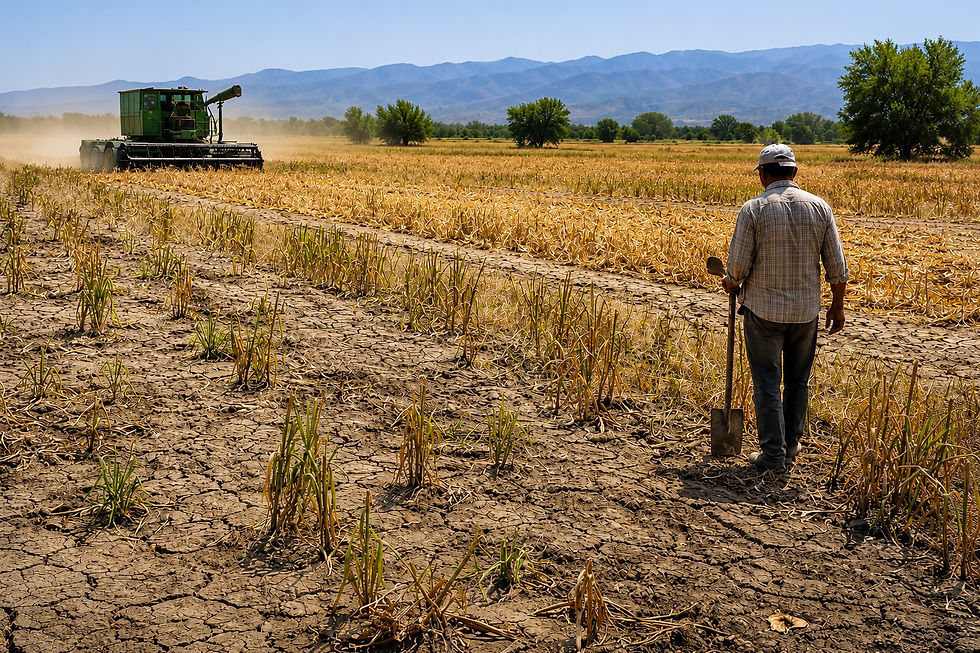
The consequences are not necessarily confined to the geographical location where a climate event occurs. Modern food systems are interconnected through international commodity markets, transportation networks, energy systems, fertilizer markets, and global trade. A severe production failure in one major agricultural region can therefore influence food prices and availability in distant countries.
This interaction becomes particularly significant when climate shocks occur alongside geopolitical or economic instability. The FAO and WFP have repeatedly highlighted the interaction between climate extremes, conflict, economic pressures, displacement, and humanitarian emergencies. Such conditions demonstrate that food insecurity is rarely caused by one factor alone. Instead, climate change increasingly acts as a multiplier of existing food-system vulnerabilities.
Why Food Security Is Not the Same as Healthy Nutrition
One of the most important distinctions in contemporary food policy is the difference between food security and nutritional adequacy. Food security generally concerns whether people have reliable physical and economic access to sufficient food. Yet a population may have sufficient calories available while simultaneously experiencing micronutrient deficiencies, poor dietary diversity, obesity, or diet-related chronic disease.
This distinction is central to the work of institutions such as the World Health Organization (WHO), UNICEF, FAO, and the World Bank. Their approaches increasingly recognize that nutrition cannot be reduced to the question of whether people consume enough calories. Human health depends upon the quality, diversity, safety, affordability, and nutritional composition of diets.
Climate change makes this distinction more important. A food system may continue to provide substantial quantities of staple commodities while becoming less capable of supplying diverse nutrient-rich foods. Fruits, vegetables, legumes, nuts, fish, and other nutrient-dense foods can become less affordable or less available when agricultural conditions deteriorate.
During periods of food-price inflation, households with limited purchasing power may consequently prioritize inexpensive and energy-dense foods. This can create a paradox in which food insecurity and diet-related health problems exist simultaneously. A household may consume sufficient calories while still lacking essential micronutrients and dietary diversity.
For this reason, the future of food policy cannot be measured exclusively by agricultural output. The relevant question is not simply how much food a food system produces, but whether it produces the right nutritional quality at a price that populations can afford.
Climate, Nutrition, and Public Health Are Becoming One Policy Challenge
The relationship between climate and nutrition increasingly requires governments to move beyond traditional institutional boundaries. Ministries of agriculture, health, environment, economic affairs, social protection, and infrastructure often address different components of the same underlying problem.
The WHO approaches climate change as a major determinant of health, while the FAO focuses extensively on sustainable and resilient agrifood systems. The World Food Programme addresses food assistance, emergency response, and resilience, particularly in fragile environments. UNICEF places particular emphasis on children and vulnerable populations, for whom inadequate nutrition can have lifelong consequences.
The United Nations Environment Programme (UNEP) contributes an environmental perspective, while the UN Framework Convention on Climate Change (UNFCCC) provides an international framework for climate policy and cooperation. The IPCC, meanwhile, provides the scientific assessment underpinning much of the international understanding of climate risks.
The convergence of these institutions reflects a fundamental change in how food is understood. Food is simultaneously an agricultural product, a public-health determinant, an economic commodity, an environmental resource, and a social necessity.
The Future of Local, Plant-Based, and Climate-Resilient Food Chains
The response to climate pressure will require greater diversification and resilience throughout food systems. Local and regional food systems can strengthen resilience by reducing certain supply-chain dependencies, supporting local producers, and increasing communities' capacity to respond to disruptions. This does not mean eliminating international trade. Rather, it means developing complementary local, regional, and global systems that are less vulnerable to individual points of failure.

Local agriculture, community-supported agriculture, urban farming, farmers' markets, regional procurement programs, and shorter distribution networks can all contribute to this objective when they are appropriately designed for local environmental and economic conditions.
Plant-based foods will also play an increasingly important role in discussions about sustainable nutrition. Diets containing greater proportions of vegetables, fruits, legumes, whole grains, nuts, and other plant foods can contribute to dietary diversity and, depending on production methods and geographical context, reduce pressure on land and other natural resources.
However, the transition should remain evidence-based. Not every plant-based food is automatically sustainable, just as not every locally produced food necessarily has a lower environmental footprint. Climate impact depends upon land use, irrigation, agricultural practices, processing, transportation, storage, energy consumption, and ecological conditions.
The future therefore lies not in one universal dietary model but in food systems adapted to local ecological realities while maintaining nutritional adequacy and affordability.
Innovation and Climate-Resilient Agriculture
Technological and agricultural innovation will be essential. Drought-resistant crops, improved irrigation systems, soil conservation, agroforestry, diversified cropping, precision agriculture, improved food storage, climate forecasting, and early-warning systems can all contribute to greater resilience.
The FAO increasingly emphasizes innovation, science, data, biodiversity, sustainable agricultural practices, and resilient food systems. Such measures are particularly important for smallholder farmers, who may have fewer financial resources to recover from crop failure or invest in adaptation.
Governments therefore have a central role in supporting the transition. Agricultural policy, climate policy, public-health policy, social protection, and food procurement should be designed with greater institutional coordination.Investments in agricultural research, rural infrastructure, water management, storage, transport, education, and social safety nets can help protect both food availability and nutritional outcomes.
The objective should not simply be to increase agricultural production. Production must become more resilient without compromising environmental sustainability or nutritional quality.
From Food Security to Nutritional Resilience
The emerging challenge is consequently larger than preventing famine. Global society must develop nutritional resilience: the capacity of populations to maintain access to diverse, safe, affordable, and nutritious diets despite environmental, economic, political, and social disruption.
The 2026 Global Report on Food Crises illustrates why this transition is urgent. Acute food insecurity continues to affect populations exposed to conflict, displacement, economic shocks, extreme weather, and fragile governance. Climate change is not the sole cause of these crises, but it can intensify pressure on already vulnerable agricultural and social systems.
The strategic implication is clear. Food policy can no longer focus exclusively on producing more food. It must also consider what food is produced, where it is produced, how it is distributed, who can afford it, how vulnerable production is to climate disruption, and whether the resulting diets adequately support human health.

Climate change is therefore transforming nutrition from a matter of individual dietary choice into a global systems challenge. The future food system will not be judged merely by its capacity to feed populations during favourable conditions. Its true resilience will be demonstrated by its ability to maintain nutritional quality during periods of environmental uncertainty and disruption.
The responsibility is shared among governments, scientific institutions, international organizations, farmers, healthcare professionals, businesses, and communities. Institutions such as the FAO, WHO, WFP, UNICEF, World Bank, IPCC, UNEP, UNFCCC, and GNAFC provide complementary scientific, humanitarian, health, environmental, and policy perspectives that can support this transformation.
Ultimately, the objective should be neither maximum production nor maximum economic efficiency in isolation. It should be the creation of food systems capable of sustaining human health, ecological stability, and social resilience simultaneously.
In a warming and increasingly volatile world, healthy food must become not only available, but climate-resilient. The future of global nutrition will depend upon whether societies can transform food systems from structures designed primarily for efficiency into systems designed for resilience, nutritional quality, environmental responsibility, and long-term human well-being.


Comments