
Antimicrobial Resistance: A Global Institutional Perspective

Updated: Jul 26
Antimicrobial resistance (AMR) has emerged as one of the most pressing global health challenges of the 21st century. It is no longer a distant or theoretical risk; it is a current and accelerating crisis that affects healthcare systems, agriculture, economies, and communities worldwide. International institutions such as the World Health Organization (WHO), the World Organisation for Animal Health (WOAH), and the Food and Agriculture Organization (FAO) have identified AMR as a critical threat requiring coordinated global action.
This article provides a comprehensive, institutional and scientific overview of antimicrobial resistance, what it is, why it occurs, who is most affected, and what strategies are being implemented globally to mitigate its impact.
What is Antimicrobial Resistance?
Antimicrobial resistance refers to the ability of microorganisms, such as bacteria, viruses, fungi, and parasites, to resist the effects of medications that were once effective in treating infections.
In practical terms, this means that standard treatments become ineffective, infections persist, and the risk of transmission increases. These resistant microorganisms are often referred to as “superbugs,” reflecting their ability to survive even advanced medical interventions.
AMR is not limited to antibiotics alone; it encompasses resistance to antivirals, antifungals, and antiparasitic drugs. This broad scope makes it a cross-cutting issue affecting human medicine, veterinary science, agriculture, and environmental systems.

Why Does Antimicrobial Resistance Occur?
Natural Evolution and Genetic Change
AMR is fundamentally a biological process. Microorganisms naturally evolve over time through genetic mutations. Some mutations enable them to survive exposure to antimicrobial drugs. These resistant strains then multiply and spread.
Misuse and Overuse of Antimicrobials
While AMR is natural, human behavior significantly accelerates the process. The inappropriate use of antibiotics, such as prescribing them for viral infections or failing to complete treatment courses, creates selective pressure that favors resistant organisms.
In agriculture, antimicrobials have historically been used not only for treating infections but also for growth promotion in livestock. This widespread use increases the likelihood of resistance developing in animal populations, which can then transfer to humans through food systems or environmental pathways.
Environmental Factors
Pharmaceutical waste, hospital effluents, and agricultural runoff introduce antimicrobial substances into ecosystems. These environments become breeding grounds for resistant microorganisms, contributing to the global spread of AMR.
Mechanisms of Resistance
Microorganisms employ several mechanisms to resist antimicrobial drugs:
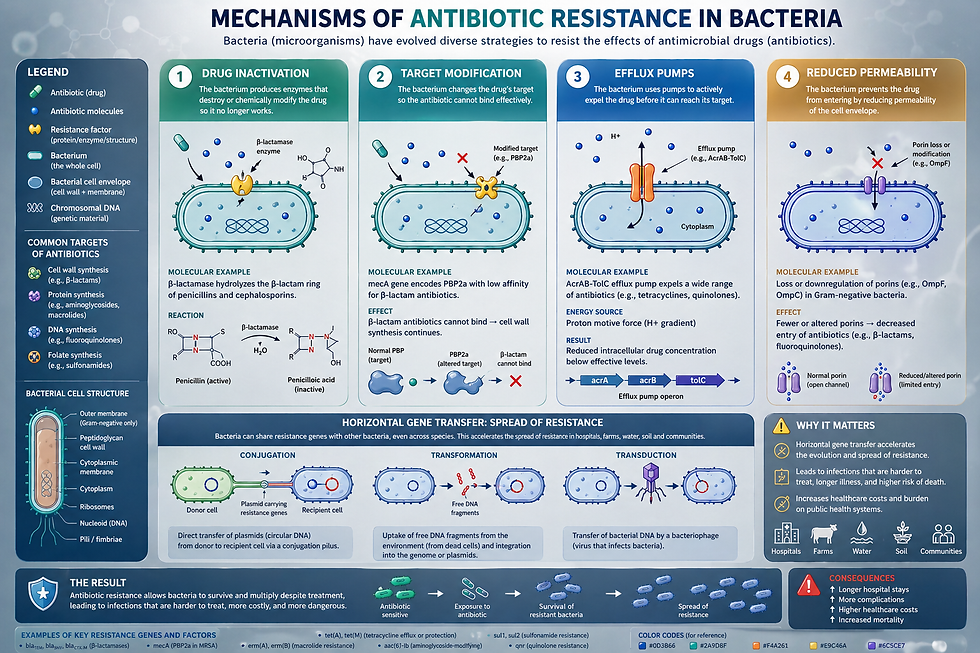
Drug inactivation: Producing enzymes that neutralize the drug
Target modification: Altering the drug’s binding site
Efflux pumps: Expelling the drug from the cell
Reduced permeability: Preventing drug entry
These mechanisms can be shared between microorganisms through horizontal gene transfer, accelerating the spread of resistance across species and environments.
The Global Impact of AMR

Health Consequences
AMR significantly undermines modern medicine. Without effective antimicrobials:
Routine surgeries become high-risk
Cancer treatments such as chemotherapy become more dangerous
Common infections can become life-threatening
In Europe alone, AMR is directly responsible for approximately 133,000 deaths annually and contributes to hundreds of thousands more.
Globally, millions of deaths are associated with resistant infections each year, highlighting the scale of the crisis.
Economic Burden
The financial impact is equally severe. In the European Union, AMR costs an estimated €11.7 billion annually due to healthcare expenses and productivity losses.
At a global level, the economic burden threatens sustainable development, particularly in low- and middle-income countries where healthcare infrastructure is limited.
Who is Most Affected?
Vulnerable Populations
Certain groups are disproportionately affected by AMR:
Hospital patients, especially those in intensive care
Children and elderly individuals
People with chronic diseases or weakened immune systems
Populations in low-resource settings
These groups often have limited access to advanced diagnostics and alternative treatments, making resistant infections more deadly.
Healthcare Systems
Hospitals and clinics face increased pressure due to longer hospital stays, more complex treatments, and higher costs. The rise of multidrug-resistant organisms complicates infection control and requires more advanced medical infrastructure.
Agriculture and Food Systems
Farmers and veterinarians also face challenges as infections in animals become harder to treat. This can lead to economic losses and risks to food security. Resistant bacteria can enter the food chain, affecting consumers globally.

A One Health Perspective
A defining feature of AMR is its interconnected nature. The One Health approach recognizes that human health, animal health, and environmental health are interdependent.
WOAH emphasizes that no single organization or sector can tackle AMR alone. Instead, coordinated action across multiple domains is essential.
For example:
Antibiotic use in livestock affects human health
Environmental contamination influences microbial evolution
Healthcare practices impact community transmission
This interconnectedness requires integrated policies and collaborative governance at both national and international levels.
Global Institutional Response
The Role of WOAH
The World Organisation for Animal Health (WOAH) plays a central role in addressing AMR, particularly within the animal health sector.
According to WOAH, combating AMR requires:
Strengthening veterinary services
Monitoring antimicrobial use in animals
Promoting responsible and prudent use of antimicrobials
Supporting global data collection and analysis
WOAH has also established an Antimicrobial Resistance Working Group to support the implementation of its global strategy.
International Collaboration
AMR is addressed through partnerships between major global institutions, including:
WHO (human health)
FAO (food and agriculture)
UNEP (environment)
WOAH (animal health)
These organizations collaborate under the Quadripartite framework, promoting coordinated action through the One Health approach.
Political and Global Initiatives
AMR has become a priority topic in global political forums such as the G20. International commitments include:
National Action Plans
Surveillance systems
Investment in research and innovation
Recent global declarations include dozens of commitments, emphasizing the urgency of collective action.
Strategies to Combat AMR
1. Prudent Use of Antimicrobials
Reducing unnecessary use is one of the most effective strategies. This includes:
Prescribing antibiotics only when necessary
Using correct dosages and treatment durations
Avoiding antimicrobials for growth promotion in animals
2. Surveillance and Data Collection
Monitoring antimicrobial use and resistance patterns allows institutions to identify trends and implement targeted interventions.
3. Infection Prevention
Preventing infections reduces the need for antimicrobials. Key measures include:
Vaccination
Hygiene and sanitation
Biosecurity in agriculture
4. Research and Innovation
Developing new antibiotics, vaccines, and diagnostic tools is critical. However, innovation has slowed due to limited financial incentives, creating a gap between emerging resistance and available treatments.
5. Education and Awareness
Public awareness campaigns, such as World AMR Awareness Week, aim to change behaviors at individual and community levels. Education systems also play a role in promoting responsible antimicrobial use.
Illustrative Examples of AMR

Hospital Infection
A patient undergoes routine surgery but develops a bacterial infection. Standard antibiotics fail due to resistance, requiring stronger, more toxic, and expensive treatments. Recovery is prolonged, and complications increase.
Agriculture and Food Chain
A livestock farm uses antibiotics to prevent disease. Over time, bacteria in the animals develop resistance. These bacteria spread through meat products or environmental exposure, contributing to human infections that are harder to treat.
Community Spread
A common infection such as a urinary tract infection becomes resistant to first-line antibiotics. Patients require multiple treatments, increasing healthcare costs and the risk of complications.
Progress and Challenges
There are signs of progress. For example, global antimicrobial use in animals has declined by approximately 13% in recent years, reflecting improved practices and policy interventions.
However, challenges remain:
Unequal access to healthcare and diagnostics
Continued misuse of antimicrobials
Limited development of new drugs
Weak regulatory systems in some regions
The pace of resistance development continues to outstrip innovation, creating a growing gap in treatment capacity.
Conclusion
Antimicrobial resistance represents a complex and multifaceted global challenge that intersects biology, medicine, agriculture, economics, and environmental science. It is driven by both natural evolutionary processes and human behavior, particularly the misuse and overuse of antimicrobial agents.
The consequences are profound: increased mortality, rising healthcare costs, and threats to modern medical practices. Vulnerable populations and low-resource regions bear a disproportionate burden, while the interconnected nature of AMR demands a unified global response.
Institutions such as WOAH, WHO, and FAO have established frameworks and strategies grounded in the One Health approach, emphasizing collaboration across sectors and disciplines. While progress has been made, sustained commitment, innovation, and behavioral change are essential to curb the spread of resistance.
Ultimately, AMR challenges humanity to rethink its relationship with medicine, ecosystems, and microbial life. The effectiveness of antimicrobial treatments, one of the greatest achievements of modern science, depends on responsible stewardship today to ensure their availability for future generations.


Comments