
The Human Memory

Understanding Human Memory How Memories Are Formed, Distorted, and Shape Who We Are
Introduction
Our memory feels reliable. We tell stories about our childhood, our successes and our failures as if they are stored in a stable inner archive. Yet modern neuroscience shows that memories are not recordings. They are reconstructions.
Human memory is a dynamic system. It filters, rewrites, strengthens, and sometimes distorts information. What we remember does not only determine what we know, it shapes how we interpret the world and how we understand ourselves.
Every experience we recall is partially rebuilt by the brain. This process makes memory flexible and adaptive, allowing us to integrate new knowledge and reinterpret past experiences. At the same time, it means that memory is not infallible.
Understanding how memory works has become increasingly important in a society characterized by rapid technological change, information overload, and continuous digital stimulation. Scientific research in neuroscience, psychology, and cognitive science is revealing how memory functions, why it sometimes misleads us, and how individuals can strengthen their cognitive capacities in an increasingly complex world.
What Is Human Memory?
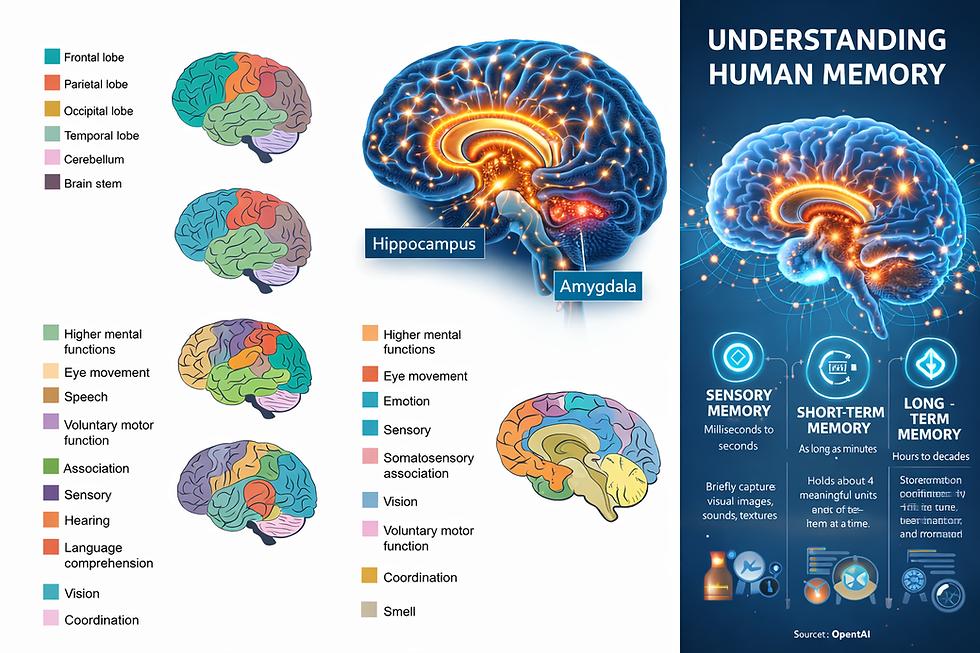
Human memory is not a simple storage system. Instead, it is a complex biological and psychological process involving the encoding, storage, and retrieval of information.
These processes rely on interactions between several regions of the brain.
The hippocampus plays a crucial role in forming new memories, particularly those related to experiences and events. The prefrontal cortex is responsible for working memory and executive functions such as planning, attention, and decision-making. Meanwhile, the amygdala attaches emotional significance to experiences, influencing which memories become strongly encoded.
Neuroscientific research conducted at institutions such as Harvard University and Stanford University has shown that memory formation is closely linked to synaptic plasticity, the strengthening and weakening of connections between neurons based on experience. Each time we learn something new, neural pathways are modified, forming networks that allow information to be retrieved later.
Importantly, memory does not function as a passive archive. When we recall an event, the brain reconstructs it using fragments of stored information combined with current context, emotions, and expectations. This reconstructive nature makes memory adaptive, enabling humans to reinterpret experiences and apply past knowledge to new situations.
From a mindfulness perspective, this insight has profound implications. If memories are mental reconstructions rather than exact recordings, our relationship with the past becomes more flexible. Awareness allows individuals to observe memories without automatically identifying with them.
The Three Main Types of Memory
Human memory can broadly be divided into three primary systems: sensory memory, working memory, and long-term memory.
Sensory Memory
Sensory memory operates at an extremely short timescale, lasting only milliseconds to a few seconds. It briefly stores raw sensory impressions such as visual images, sounds, and tactile sensations.
This system functions as a filtering mechanism. Only information deemed relevant is passed on to working memory, preventing the brain from becoming overwhelmed by the enormous amount of sensory input present in any environment.
Working Memory
Working memory serves as the brain’s mental workspace. It temporarily holds information needed for reasoning, reading, problem-solving, and decision-making.
In 1956, psychologist George A. Miller proposed that individuals can hold approximately seven pieces of information, plus or minus two, in working memory at one time. In practical terms, this means that most people can remember between five and nine items briefly without writing them down.
However, modern research has refined this estimate. When researchers control for strategies such as rehearsal or grouping, the effective capacity of working memory appears closer to four meaningful units of information, often referred to as “chunks.”
A chunk does not necessarily represent a single digit or word. Instead, it represents a meaningful unit of information. For example, the numbers 1-9-4-5 could be remembered as four separate digits, but if recognized as the year 1945, they become one chunk of information.
This principle, known as chunking, allows individuals to expand the effective capacity of working memory by organizing information into structured patterns.
Neuroscientific studies indicate that the prefrontal cortex is essential for maintaining and manipulating these limited information units. When working memory becomes overloaded, for example through constant multitasking or digital interruptions, cognitive performance declines significantly.
This limitation explains why multitasking is inefficient, why excessive information leads to mental fatigue, and why complex ideas must be presented in structured segments for effective learning.
Long-Term Memory
Long-term memory stores information over extended periods, ranging from hours to decades. It can be divided into three major categories:
• Episodic memory: Personal experiences and events
• Semantic memory: Factual knowledge and concepts
• Procedural memory: Learned skills such as driving or playing an instrument
The transfer of information from working memory into long-term memory occurs through a process called consolidation.
Two factors strongly enhance this process.
First, emotion significantly strengthens memory formation. Emotional experiences activate the amygdala, which enhances consolidation processes within the hippocampus. Events associated with strong emotional responses are therefore more likely to be remembered vividly.
Secondly, repetition over time reinforces neural pathways. Spaced repetition, revisiting information at intervals rather than cramming it all at once, strengthens memory retention and is widely used in education and cognitive training.
What we repeatedly encounter and what emotionally affects us becomes embedded in long-term memory, gradually shaping our knowledge and personal narratives.

Why Memories Become Distorted
Despite our confidence in them, memories are surprisingly malleable.
They change over time due to new information, emotional reinterpretation, social influence, and narrative reconstruction. Each time a memory is recalled, it becomes temporarily unstable and can be subtly modified before being stored again.
One of the most influential researchers in this field is psychologist Elizabeth Loftus, whose work fundamentally transformed the scientific understanding of memory reliability.
Through a series of controlled experiments, Loftus demonstrated that it is possible to implant entirely false memories in individuals. In one famous study, participants were led to believe that they had been lost in a shopping mall as a child, an event that had never actually occurred. Remarkably, a significant number of participants later reported vivid details about this fabricated experience.
Her research revealed several important insights.
Eyewitness testimony, often considered highly reliable, can be influenced by suggestion. The wording of questions can alter recollections, and individuals can become confident in memories that are objectively inaccurate.
Loftus’s findings have had profound implications for legal systems worldwide, encouraging more careful interrogation practices and highlighting the fallibility of human recollection.
For readers, the lesson is both cautionary and empowering. Memory is not a fixed recording of reality. It is a flexible process influenced by context and interpretation. Recognizing this can encourage greater critical thinking and humility in how we interpret past experiences.
Memory and Identity
Memory does more than store information. It constructs identity.
Our sense of self is built upon remembered experiences, moments of achievement, failure, relationships, challenges, and growth. These memories form the narrative through which individuals interpret their lives.
Philosophers such as John Locke argued that personal identity is closely tied to memory continuity. According to this view, the reason we perceive ourselves as the same person over time is because we remember being that person.
Modern psychological research supports this idea. Studies on autobiographical memory show that individuals rely on remembered life events to construct a coherent sense of self. When memory becomes impaired, as in certain neurological conditions, this continuity of identity can weaken.
However, the reconstructive nature of memory introduces an important insight.
If memories can be reinterpreted, then identity is not entirely fixed.
Therapeutic practices in psychology often involve reframing past experiences. While the factual events themselves may remain unchanged, the emotional interpretation of those events can evolve. Individuals can reinterpret difficult experiences as sources of resilience or growth.
Mindfulness-based approaches emphasize observing thoughts and memories without attachment or judgment. From this perspective, memories are mental events rather than absolute definitions of the self.
This understanding opens the possibility for personal transformation. By changing how we relate to our memories, we gradually reshape the narrative of who we believe we are.
Memory in the Age of Technology
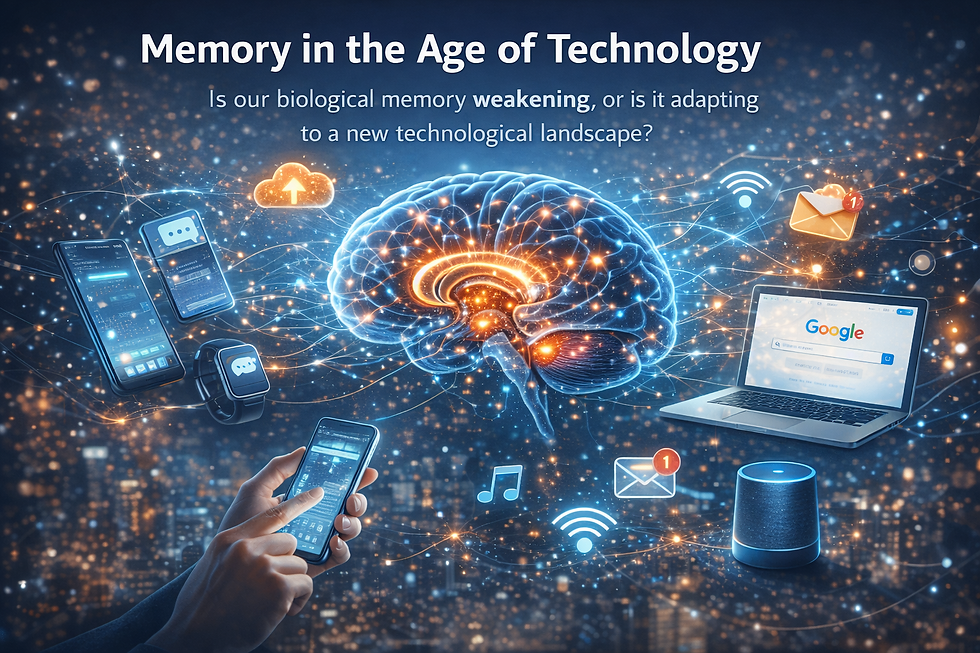
Modern society has introduced an unprecedented cognitive environment. Smartphones, digital media, and constant connectivity have fundamentally altered how people access and process information.
This raises an important question:
Is our biological memory weakening, or is it adapting to a new technological landscape?
Some research suggests that reliance on digital devices may reduce active recall. A phenomenon sometimes referred to as the “Google Effect” indicates that when people know information is easily accessible online, they are less likely to commit it to memory.
Studies on media multitasking have also shown that frequent switching between tasks can impair working memory efficiency and attention control.
However, another perspective suggests that the brain may simply be adapting. Humans have long relied on external memory systems. From written language to printed books and digital databases. These tools allow cognitive resources to shift toward analysis, creativity, and problem-solving.
From this perspective, technology does not necessarily weaken memory; it redistributes cognitive effort.
Today, global research initiatives and technology companies increasingly invest in neuroscience-informed design, digital wellness tools, and cognitive optimization platforms. Modern products and services increasingly integrate behavioral science, cognitive testing, and attention management to support human performance.
Rather than witnessing cognitive decline, society may be experiencing a transition toward a new model of distributed cognition, where biological memory and technological systems work together.
The critical factor remains conscious usage. Technology can fragment attention, or extend human capability.
Strengthening Memory
Although memory capacity has natural limitations, research shows that individuals can significantly strengthen memory performance through behavioral practices.
One of the most important factors is sleep. During deep sleep phases, the brain consolidates information from the hippocampus into long-term cortical storage. Studies conducted at the University of California, Berkeley have demonstrated that sleep plays a crucial role in stabilizing newly learned information.
Spaced repetition is another powerful method. Instead of reviewing information repeatedly within a short time frame, distributing study sessions across longer intervals improves retention dramatically.
Emotional engagement also enhances memory. Information that carries personal meaning or emotional significance is more likely to be encoded deeply.
Focused attention is equally essential. Mindfulness meditation has been shown in multiple studies to improve working memory capacity and reduce mind-wandering by strengthening attentional control networks.
Finally, physical exercise supports cognitive health. Aerobic activity increases levels of brain-derived neurotrophic factor (BDNF), a protein that supports neuronal growth and synaptic plasticity.
For readers, the implication is clear. Memory is not only a biological function; it is a trainable capacity shaped by habits of attention, lifestyle, and mental engagement.
Conclusion
Human memory is neither perfect nor fragile. It is adaptive.
It enables learning, supports identity, and allows individuals to interpret their experiences. At the same time, it remains susceptible to distortion and reinterpretation.
Scientific research continues to deepen our understanding of how memories are formed, stored, and recalled. As society evolves technologically, the relationship between biological memory and digital systems will continue to transform.
Yet one principle remains constant.
Where attention goes, memory follows.
In a world saturated with information, cultivating attention may be one of the most powerful cognitive skills individuals can develop. Strengthening memory is therefore not only a matter of brain function, it is a matter of how consciously we choose to engage with the world around us.


Comments