
The May Day Holiday and the Motorcycle Wake-Up Parade

How a Loud, Roaring Tradition in Bjelovar Has Become a Global Symbol of May Day, Community, and Workers’ Spirit
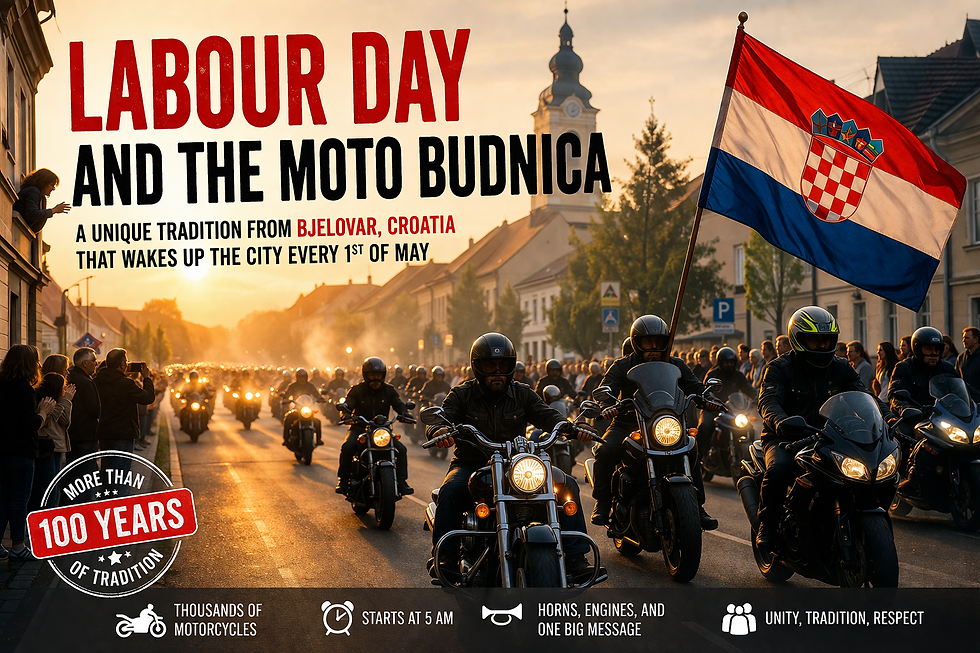
Today is May 1st, and around the world, people celebrate International Workers’ Day. Every place marks this day in its own way, but in my hometown, there’s a celebration so unique that it doesn’t exist anywhere else on earth: the motorcycle wake-up parade in Bjelovar, Croatia.
Imagine thousands of motorcycles of all kinds, shapes, and sizes, at 5:00 a.m. on May 1st, riding in a long column through the entire city. Engines roar, horns blare, and the noise wakes up residents, who slowly peek out of their windows, pull back the curtains, and watch a seemingly endless procession roll past.
This unusual phenomenon is called the "Moto Budnica", a traditional motorcycle procession that has taken place for decades. It’s a living monument to tradition and community that links the past with today’s vibrant motorcycle culture. This event is loud and unexpected, deeply rooted in the history of labor movements, and part of the city’s contemporary identity.
The Origins of International Workers’ Day and Its Historical Meaning
This holiday has deep roots in the history of the labor movement and the fight for workers’ rights. It’s more than just a day off. International Workers’ Day is a symbol of the struggle for labor rights and the dignity of work. Today, it is observed in dozens of countries every May 1st, but its origins go back to the turbulent decades of the Industrial Revolution and social upheaval of the late 19th century.
At that time, work hours were unregulated. Laborers often worked 10, 12, or even 14- or 16-hour shifts in dangerous, unsafe conditions, with no clear safety standards or fair wages.
At the heart of what became May Day was the demand for an eight-hour workday, an idea that emerged in the late 19th century and became the central goal of workers’ organizations across industrialized nations.
A crucial moment came in 1884 in Chicago, when the American Federation of Labor called for an eight-hour workday with the slogan “eight hours labor, eight hours recreation, eight hours rest.” This led to mass strikes across the United States beginning on May 1st, 1886.
The climax of this struggle came with the Haymarket affair in Chicago on May 4th, 1886, when a peaceful workers’ protest turned violent after a bomb was thrown at police. What followed was brutal repression: several policemen and protesters were killed, and numerous labor leaders were arrested and convicted under controversial circumstances, some even executed. This moment became a tragic symbol of the labor class’s fight for basic rights.
A few years later, at the Second International Congress in Paris in 1889, representatives of socialist and workers’ organizations decided to declare May 1st as the international day of worker solidarity, in memory of these events and as a continuation of the fight for better working conditions and a fairer society. This decision focused the attention of labor movements worldwide and gave International Workers’ Day its global character.
Although today, May Day is often seen simply as a day off or an opportunity for family barbecues and celebrations, it carries a layered historical story. It reminds us of the difficult path toward workers’ rights that, especially in Western countries, many now take for granted: eight-hour workdays, workplace safety measures, collective bargaining, and social security protections.
Watch the video:
The Motorcycle Wake-Up Parade as a Protest for Workers’ Rights
The Moto Budnica is essentially a motorcycle procession that also arose as a form of protest by workers, drawing attention to the struggle for their rights.
According to local sources and oral tradition, the roots of this event stretch back to the early 20th century, at least as far as the 1920s, although the first written record of the moto budnica dates to around 1946 or 1947.
In its early decades, the Budnica wasn’t organized like today’s public event with planned routes, police escorts, and official programming. It began as an informal, often secret gathering of workers and motorcyclists.
No one can say with certainty who exactly “started” the first motorcycle wake-up parade in Bjelovar, or the exact date it first happened, because the tradition was born out of a collective, spontaneous act by workers rather than a formal event with documented organizers.
Those early participants would ride their motorcycles in the early morning hours, often without mufflers, through the city and to nearby picnic areas. The noisy riding was a way to express dissatisfaction with working conditions and society at large. Even though it was loud and chaotic, it was also a joyful, ritualistic way of bringing the workers’ community together at the very beginning of the May Day celebrations.
This spontaneous protest by the working masses was repeated every year on May 1st and gradually evolved into a stable tradition that continues to this day.
In the years after World War II, the spirit of the labor movement remained in the background, but the Moto Budnica became more a part of local culture.
During the era of Tito’s Yugoslavia, the parade was still held, but in a different context. It was not hidden, but neither was it emphasized as a symbol of resistance. The event took place fairly openly, but without the large-scale official organization known today. Locally, workers and motorcycle enthusiasts continued this early-morning ride through the city.
Over the decades, this practice continued almost every May 1st in various forms, with pauses and shifts in character from decade to decade.

The Moto Budnica Today and Its Modern Meaning
Today’s modern moto budnica begins near the end of the night on April 30th, no later than around 4:00 a.m. on May 1st, and its organization has been taken over by the Moto Club Bjelovar. At this time, participants, motorcyclists from Bjelovar and all across Croatia, begin gathering near the Hall of European Champions, dressed in protective gear and ready for the ride.
These days, riders come not only from Croatia but also from abroad, including Bosnia and Herzegovina, Slovenia, Austria, and Germany.
An organized police escort with sirens and lights accompanies the motorcyclists at the head and tail of the column to regulate traffic and ensure the event proceeds smoothly.
At around 5:00 a.m., a column of several thousand motorcycles sets off through the city’s streets in a winding procession that may last an hour or more, depending on the number of participants and the route of that year’s parade. The roar of the engines “wakes” the people of Bjelovar and symbolically marks the beginning of the celebration of International Workers’ Day.
After the ride, there are often other activities such as communal gatherings, sharing of bean stew, beer, and cakes, cultural programs, or laying wreaths. The city of Bjelovar includes this tradition in the broader May Day celebration, and the moto budnica becomes a sign that the community is ready for another day of coming together and socializing.
The modern meaning of this event still focuses on the struggle for workers’ rights, while also highlighting the need for safe, organized riding by motorcyclists.
In recent years, the Moto Budnica has gained official recognition and protection as an intangible cultural heritage of the Republic of Croatia. This status gives the tradition an institutional framework, preserves it, and allows for further study of historical sources and practices to ensure this unique custom remains alive and recognized in the years to come. That designation also confirms its impact on Bjelovar’s identity and its importance to the local community.
Conclusion
May Day is a deeply important day with a long and difficult history. The way it is celebrated in Bjelovar, in a completely authentic and distinct manner, has transformed the original defiance and rebellion into a lively, joyful tradition.
The methods our ancestors used to confront an unjust system have become something that connects and delights people, not only in my hometown but also those who travel from afar, even from other countries.
We mustn’t forget why workers first rose, but it’s wonderful to see that people celebrate on May 1st, and that this unusual tradition has endured for more than 100 years.


This is a test message!😀
Feel free to comment!