
Happy Chinese New Year

Updated: Apr 7, 2024
The Chinese New Year is the most important of all traditional Chinese celebrations. It dates from the time of the Shang dynasty (1600 BC - 1100 BC), when people worshiped gods and ancestors around the turn of the year. Only much later did it become a festival in which the old year was said goodbye and the new year was welcomed. The date of the Chinese New Year is determined by the lunar calendar and not the solar calendar. The Chinese New Year begins on the second new moon after the solstice of December 21. According to our calendar, that is somewhere between January 21 and Februari 20.
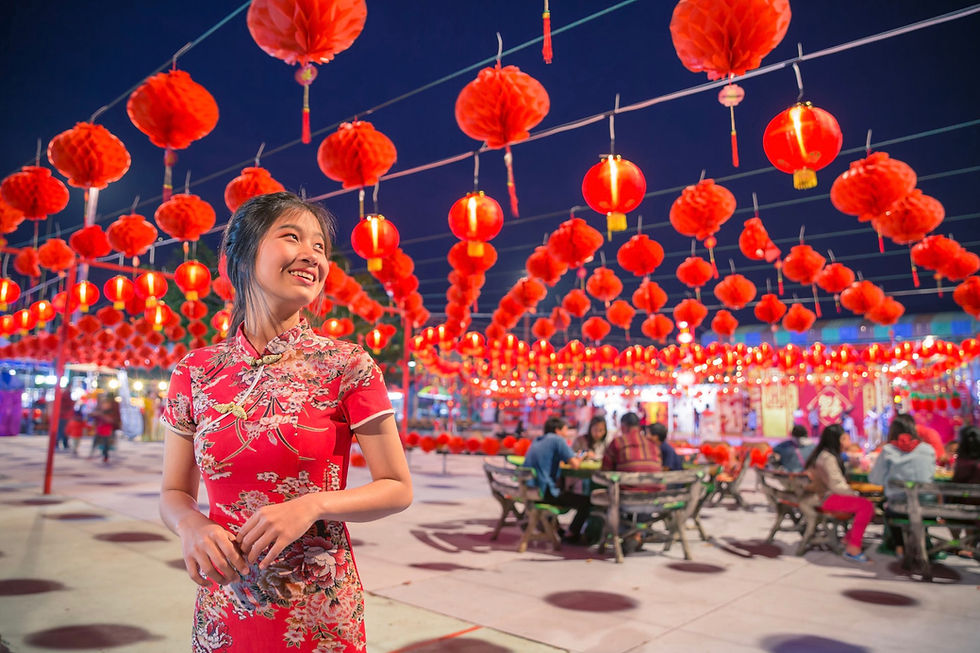
The Chinese New Year announces the beginning of spig and is therefore called 'Spring Festival'.
With singing and dancing people plowing and sowing season. On the days before the New Year celebration, people buy gifts, decorations, special food and new clothes. The house thoroughly cleaned on New Year's Eve - 'Chuxi' - and decorated with paper-cut sayings and two rhyming lines expressing happiness, prosperity and longevity.
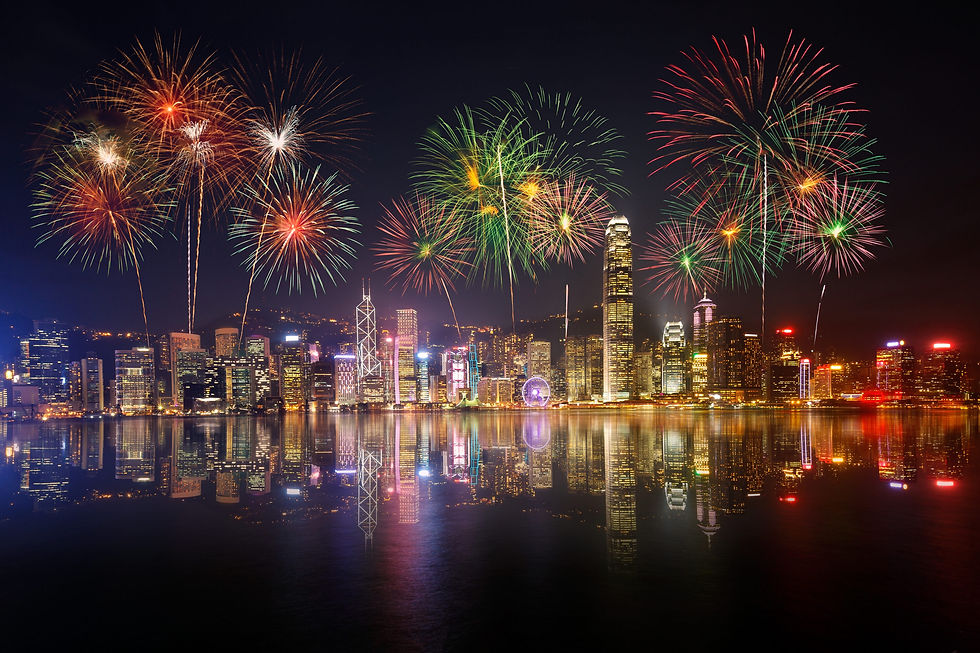
New Year I a family celebration. No matter how far people are from home, they do their utmost to enjoy the New Year's dinner with the whole family. That is why there is a real migration of people in China in the days before the Chinese New Year. Millions of people then travel to their native village to celebrate the New Year there. On New Year's Day they visit friends and acquaintances to wish each other the best for the New Year. It is a big fun party, not only at home with the family, but also on the street. There is a lot of eating and drinking and of course there are lots of loud fireworks.

Chinese New Year or the Spring Festival (see also § Names) is a festival that celebrates the beginning of a new year on the traditional lunisolar Chinese calendar. Marking the end of winter and the beginning of spring, observances traditionally take place from Chinese New Year's Eve, the evening preceding the first day of the year, to the Lantern Festival, held on the 15th day of the year. The first day of Chinese New Year begins on the new moon that appears between 21 January and 20 February.[a]
Chinese New Year is one of the most important holidays in Chinese culture. It has influenced similar celebrations in other cultures, commonly referred to collectively as Lunar New Year, such as the Losar of Tibet, the Tết of Vietnam, the Korean New Year, and the Ryukyu New Year.[3][4][5] It is also celebrated worldwide in regions and countries that house significant Overseas Chinese or Sinophone populations, especially in Southeast Asia. These include Singapore,[6] Brunei, Cambodia, Indonesia, Malaysia, Myanmar,[7] the Philippines,[8] Thailand, and Vietnam. It is also prominent beyond Asia, especially in Australia, Canada, France, Mauritius,[9] New Zealand, Peru,[10] South Africa, the United Kingdom, and the United States, as well as in many European countries.[11][12][13]
The Chinese New Year is associated with several myths and customs. The festival was traditionally a time to honour deities as well as ancestors.[14] Within China, regional customs and traditions concerning the celebration of the New Year vary widely,[15] and the evening preceding the New Year's Day is frequently regarded as an occasion for Chinese families to gather for the annual reunion dinner. It is also a tradition for every family to thoroughly clean their house, in order to sweep away any ill fortune and to make way for incoming good luck. Another practiced custom is the decoration of windows and doors with red paper-cuts and couplets. Popular themes among these paper-cuts and couplets include good fortune or happiness, wealth, and longevity. Other activities include lighting firecrackers and giving money in red envelopes.
Names
In Chinese, the festival is commonly known as the "Spring Festival" (traditional Chinese: 春節; simplified Chinese: 春节; pinyin: Chūnjié),[16] as the spring season in the lunisolar calendar traditionally starts with lichun, the first of the twenty-four solar terms which the festival celebrates around the time of the Chinese New Year.[17] The name was first proposed in 1914 by Yuan Shikai, who was at the time the interim president of the Republic of China.[18] The official usage of the name "Spring Festival" was retained by the government of the People's Republic of China, but the government of the Republic of China based in Taiwan has since adopted the name "Traditional Chinese New Year".[19]
The festival is also called "Lunar New Year" in English, despite the traditional Chinese calendar being lunisolar and not lunar. However, "Chinese New Year" is still a commonly-used translation for people of non-Chinese backgrounds.[20] Along with the Han Chinese inside and outside of Greater China, as many as 29 of the 55 ethnic minority groups in China also celebrate Chinese New Year. Korea, Vietnam, Singapore, Malaysia, Indonesia and the Philippines celebrate it as an official festival.[20]
Dates in Chinese lunisolar calendar
See also: Chinese calendar
The largest Chinese New Year parade outside Asia, in Chinatown, Manhattan
Traditional paper cutting with the character 春 ('spring'))
Chinese New Year decorations along New Bridge Road in Singapore
Chinese New Year eve in Meizhouon 8 February 2005
The Chinese calendar defines the lunisolar month containing the winter solstice as the eleventh month, meaning that Chinese New Year usually falls on the second new moon after the winter solstice (rarely the third if an intercalary month occurs[b]).[21][2] In more than 96% of years, the Chinese New Year is the closest new moon to the beginning of spring (lichun) according to the calendar. In the Gregorian calendar, the Chinese New Year occurs on the new moon that falls between 21 January and 20 February.[22]
Mythology
Hand-written Chinese New Year's poetry pasted on the sides of doors leading to people's homes, Lijiang, Yunnan
According to legend, Chinese New Year started with a mythical beast called the Nian (a beast that lives under the sea or in the mountains) during the annual Spring Festival. The Nian would eat villagers, especially children in the middle of the night.[23] One year, all the villagers decided to hide from the beast. An older man appeared before the villagers went into hiding and said that he would stay the night and would get revenge on the Nian. The old man put red papers up and set off firecrackers. The day after, the villagers came back to their town and saw that nothing had been destroyed. They assumed that the old man was a deity who came to save them. The villagers then understood that Yanhuang had discovered that the Nian was afraid of the color red and loud noises.[23] Then the tradition grew when New Year was approaching, and the villagers would wear red clothes, hang red lanterns, and red spring scrolls on windows and doors and used firecrackers and drums to frighten away the Nian. From then on, Nian never came to the village again. The Nian was eventually captured by Hongjun Laozu, an ancient Taoist monk.[24]

History
Before the new year celebration was established, ancient Chinese gathered and celebrated the end of harvest in autumn. However, this was not the Mid-Autumn Festival, during which Chinese gathered with family to worship the Moon. In the Classic of Poetry, a poem written during Western Zhou (1045 BC – 771 BC) by an anonymous farmer, described the traditions of celebrating the 10th month of the ancient solar calendar, which was in autumn.[25] According to the poem, during this time people clean millet-stack sites, toast guests with mijiu (rice wine), kill lambs and cook their meat, go to their masters' home, toast the master, and cheer the prospect of living long together. The 10th-month celebration is believed to be one of the prototypes of Chinese New Year.[26]The records of the first Chinese new year celebration can be traced to the Warring States period (475 – 221 BC). In the Lüshi Chunqiu, in Qin state an exorcism ritual to expel illness, called "Big Nuo", was recorded as being carried out on the last day of the year.[27][28] Later, Qin unified China, and the Qin dynasty was founded; and the ritual spread. It evolved into the practice of cleaning one's house thoroughly in the days preceding Chinese New Year.
The first mention of celebrating at the start of a new year was recorded during the Han dynasty (202 BC – 220 AD). In the book Simin Yueling (四民月令), written by the Eastern Han agronomist Cui Shi (崔寔), a celebration was described: "The starting day of the first month, is called Zheng Ri. I bring my wife and children, to worship ancestors and commemorate my father." Later he wrote: "Children, wife, grandchildren, and great-grandchildren all serve pepper wine to their parents, make their toast, and wish their parents good health. It's a thriving view."[29] The practice of worshipping ancestors on New Year's Eve is maintained by Chinese people to this day.[30]
Han Chinese also started the custom of visiting acquaintances' homes and wishing each other a happy new year. In Book of the Later Han, volume 27, a county officer was recorded as going to his prefect's house with a government secretary, toasting the prefect, and praising the prefect's merit.[31][32]
During the Jin dynasty (266–420), people started the New Year's Eve tradition of all-night revelry called shousui(守歲). It was described in Western Jin general Zhou Chu's article Fengtu Ji (風土記, 'Notes on Local Conditions'): "At the ending of a year, people gift and wish each other, calling it Kuisui (饋歲, 'time for gifts'); people invited others with drinks and food, calling it Biesui (別歲, 'sending off the year'); on New Year's Eve, people stayed up all night until sunrise, calling it Shousui (守歲, 'guard the year')."[33] The article used the phrase chuxi (除夕) to indicate New Year's Eve—a phrase still used today.
The Northern and Southern dynasties book Jingchu Suishiji describes the practice of firing bamboo in the early morning of New Year's Day,[34] a New Year's tradition of the ancient Chinese. Poet and chancellor of the Tang dynasty, Lai Gu, also described this tradition in his poem Early Spring (早春): "新曆才將半紙開,小亭猶聚爆竿灰", meaning "Another new year just started as a half opening paper, and the family gathered around the dust of exploded bamboo pole."[35] The practice was used by ancient Chinese people to scare away evil spirits, since bamboo would noisily crack and explode from firing.
During the Tang dynasty, people established the custom of sending bai nian tie (拜年帖, "New Year's greetings"), New Year's greeting cards. It is said that the custom was started by Emperor Taizong of Tang. The emperor wrote "普天同慶" ("whole nation celebrates together") on gold leaves and sent them to his ministers. Word of the emperor's gesture spread, and later it became the custom of people in general, who used Xuan paper instead of gold leaves.[36] Another theory is that bai nian tie was derived from the Han dynasty's name tag, men zhuang (門狀, "door opening"). As imperial examinations became essential and reached their heyday under the Tang dynasty, candidates curried favor to become pupils of respected teachers in order to get recommendation letters. After obtaining good examination marks, a pupil went to the teacher's home with a men zhuang to convey their gratitude. Eventually, men zhuang became a symbol of good luck, and people started sending them to friends on New Year's Day, calling them by a new name, bai nian tie.[37]
Spring couplets written by Qianlong Emperor of Qing dynasty, now stored in The Palace Museum
The Chunlian (Spring Couplets) was written by Meng Chang, an emperor of the Later Shu (935–965 AD), during the Five Dynasties and Ten Kingdoms period:"新年納餘慶,嘉節號長春" ("Enjoying past legacies in the new year, the holiday foreseeing the long-lasting spring"). As described by Song dynasty official Zhang Tangying in his book Shu Tao Wu, Volume 2: on the day of New Year's Eve, the emperor ordered the scholar Xin Yinxun to write the couplets on peach wood and hang them on the emperor's bedroom door.[38][39] It is believed that placing the couplets on the door to the home in the days preceding the new year was widespread during the Song dynasty. The famous Northern Song politician, litterateur, philosopher, and poet Wang Anshi recorded the custom in his poem "元日" ("New Year's Day").[40]
爆竹聲中一歲除,春風送暖入屠蘇。千門萬戶曈曈日,總把新桃換舊符。 | Amid the sound of firecrackers a year has come to an end,The spring wind has wafted warm breath to the Tusu wine.While the rising sun shines over each and every household,People get rid of the old couplets and put up the new ones. |
—王安石, 元日 | —Wang Anshi, New Year's Day |

Chinese firecracker
The poem Yuan Ri (元日) also includes the word bao zhu (爆竹, "exploding bamboo"), which is believed to be a reference to firecrackers, instead of the previous tradition of firing bamboo, both of which are called the same in the Chinese language. After gunpowder was invented in the Tang dynasty and widely used under the Song dynasty, people modified the tradition of firing bamboo by filling the bamboo pole with gunpowder, which made for louder explosions. Later under the Song, people discarded the bamboo and started to use paper to wrap the gunpowder in cylinders, in imitation of the bamboo. The firecracker was still called bao zhu (爆竹), thus equating the new and old traditions. It is also recorded that people linked the firecrackers with hemp rope and created the bian pao (鞭炮, "gunpowder whip") in the Song dynasty. Both bao zhu (爆竹) and bian pao (鞭炮) are still used today to celebrate the Chinese New Year and other festive occasions.[41]
It was also during the Song dynasty that people started to give money to children in celebration of a new year. The money was called sui nian qian (随年钱, "money based on age"). In the chapter, "Ending of a Year" (歲除) in Wulin jiushi (武林舊事), concubines of the emperor prepared a hundred and twenty coins for princes and princesses to wish them longevity.[42]
New Year's celebrations continued under the Yuan dynasty, when people also gave nian gao (年糕, "year cakes") to relatives.[43]
The tradition of eating Chinese dumplings jiaozi (餃子) was established under the Ming dynasty at the latest. It is described in the book Youzhongzhi (酌中志): "People get up at 5 in the morning of new year's day, burn incense and light firecrackers, throw door latch or wooden bars in the air three times, drink pepper and thuja wine, eat dumplings. Sometimes put one or two silver currency inside dumplings, and whoever gets the money will attain a year of fortune."[44] Modern Chinese people also put other food that is auspicious into dumplings such as dates, which prophesy a flourishing new year; candy, which predicts sweet days; and nian gao (年糕, "year cakes"), which foretells a rich life.
In the Qing dynasty, the name ya sui qian (壓歲錢, "New Year's Money)" was money given to children during New Year's. The book Qing Jia Lu (清嘉錄) recorded: "elders give children coins threaded together by a red string, and the money is called Ya Sui Qian."[45] The term is still used by Chinese people today. The money was presented in two forms: coins strung on red string or colourful purses filled with coins.[46]
In 1928, the ruling Kuomintang party decreed that the Chinese New Year would fall on 1 Jan of the Gregorian Calendar, but this was abandoned due to overwhelming opposition. In 1967, during the Cultural Revolution, official Chinese New Year celebrations were banned in China. The State Council of the People's Republic of China announced that the public should "change customs" and have a "revolutionized and fighting Spring Festival." Since people needed to work on Chinese New Year's Eve, they would not need holidays during the Spring Festival. In 1980, the traditional Chinese New Year celebrations were reinstated.[47]


Comments