
Communication Breakdown: Donald Trump’s Messaging on the Iran War and Its Implications for Global Order

The outbreak of the 2026 war involving the United States, Israel, and Iran has not only reshaped geopolitical alignments but also exposed significant weaknesses in presidential communication. President Donald Trump’s communication strategy has become one of the most controversial aspects of the conflict. Far from presenting a coherent doctrine, his messaging -particularly through his social media platform Truth Social- has been marked by contradictions, inflammatory rhetoric, and an unconventional tone that has alarmed allies, confused policymakers, and raised serious concerns about the future of international relations. This breakdown in communication is not merely a stylistic issue. It has tangible implications for diplomacy, global stability, and the credibility of the United States as a leading actor in the international system.
Social Media and the Personalization of War Communication
A defining feature of Trump’s communication strategy has been his reliance on Truth Social as a primary channel for wartime messaging. Unlike traditional communication frameworks -typically mediated through institutional actors such as the State Department- Trump has frequently issued direct statements to both domestic and international audiences in real time. These posts have included threats, declarations of victory, and criticisms of allies, often without coordination with official strategy.
This approach reflects a broader trend identified in academic literature on political communication: leaders may use personalized media ecosystems to shape narratives and bypass institutional constraints. An a look at Trump’s prior communication patterns suggests that messaging on Truth Social can shift rapidly in response to political pressures, reinforcing a model of highly reactive and individualized communication rather than coordinated strategic messaging.
In the context of war, however, such personalization carries significant risks. Wartime communication traditionally prioritizes coherence, predictability, and alignment across governmental actors. The decentralization of messaging into a single leader’s social media output disrupts this model, reducing the role of institutional checks and increasing the likelihood of inconsistency.
Contradictions and the Absence of Strategic Clarity
One of the most widely noted features of Trump’s communication during the Iran war has been the presence of frequent contradictions. His statements and public messaging indicate that the stated objectives of the war have shifted repeatedly. U.S. justifications for the conflict have included preventing an imminent Iranian attack, dismantling nuclear capabilities, achieving regime change, and responding to regional instability. These rationales have not been consistently articulated, and in some cases have directly contradicted one another.
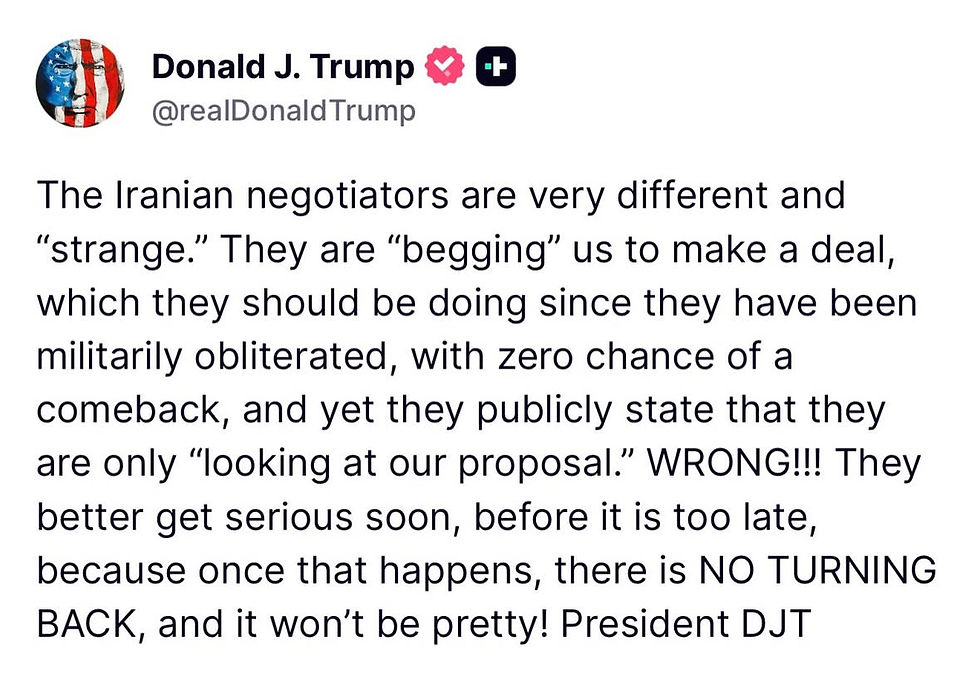
For instance, Trump has claimed that Iran’s nuclear capabilities were already “obliterated,” while continuing to justify military action as necessary to eliminate that same threat. Similarly, he has asserted that the United States does not require allied support, yet simultaneously called on other countries to assist in securing strategic objectives such as the Strait of Hormuz.
Scholars and analysts argue that such contradictions are not merely rhetorical inconsistencies but reflect deeper issues in policy formulation. These inconsistencies obscure the strategic logic of the war and limit democratic accountability by preventing the public from understanding its true objectives.
This lack of clarity has significant implications. In international relations theory, credible signaling is essential for deterrence and negotiation. When a state’s objectives are unclear or internally inconsistent, both allies and adversaries face greater uncertainty, increasing the risk of miscalculation.
Escalatory Rhetoric and Normative Erosion

In addition to inconsistency, Trump’s communication has been marked by an unusually escalatory tone. There are multiple instances in which the president publicly threatened large-scale destruction of Iranian infrastructure and civilian systems.

For example, statements warning of the potential destruction of “an entire civilization” and threats to target infrastructure such as power plants and bridges have drawn strong criticism from legal scholars and policymakers. Such rhetoric raises serious concerns under international humanitarian law, which prohibits indiscriminate attacks on civilian targets.

From a theoretical perspective, this type of communication challenges established norms governing the conduct of war. The international system relies not only on material capabilities but also on shared expectations regarding acceptable behavior. Publicly articulating positions that appear to disregard these norms may contribute to their erosion.
Indeed, threatening civilian infrastructure is unlikely to achieve strategic objectives and may instead provoke escalation, including retaliatory attacks on regional energy systems.
Thus, the issue is not solely ethical but strategic: escalatory rhetoric may reduce the effectiveness of coercive diplomacy while increasing the likelihood of broader conflict.
Narrative Instability and Rapid Message Shifts
A related problem is the instability of the narrative surrounding the war. Given that Trump’s statements about the conflict’s progress, objectives, and potential outcomes have changed frequently -sometimes within short timeframes, key questions -such as the war’s goals and timeline- have received different answers, depending on the speaker or context. This fluidity creates a fragmented narrative environment in which neither domestic nor international audiences can form a consistent understanding of policy.
Further examples include conflicting claims about military success and alliance dynamics. In some instances, Trump has declared decisive victory while simultaneously calling for increased international cooperation. Such inconsistencies undermine the credibility of official statements and complicate efforts to maintain a unified strategic narrative.
From an academic standpoint, narrative coherence is a key component of effective statecraft. A stable narrative allows states to align domestic support, reassure allies, and signal intentions to adversaries. Its absence, by contrast, contributes to what scholars describe as “information disorder,” in which competing and contradictory messages reduce overall clarity.
Implications for Alliances and Diplomatic Relations
Trump’s communication style has also had notable effects on U.S. alliances. Reports indicate that inconsistent messaging has generated confusion not only among observers but within the administration itself, with advisers expressing uncertainty about the president’s strategic direction.
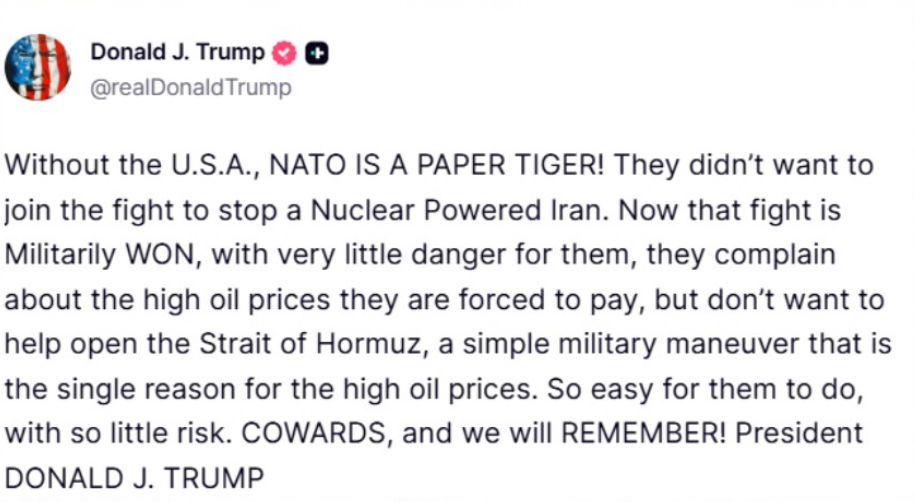
In international relations, alliances depend on trust, predictability, and shared expectations. When a leading state communicates in ways that appear inconsistent or improvisational, it may weaken these foundations. Allies may become less willing to commit resources or support policies if they cannot reliably anticipate future actions.
Moreover, public criticism of allies -combined with contradictory statements about the necessity of their support- may accelerate trends toward strategic autonomy among partner states. This could lead to a more fragmented international system, in which cooperation becomes more conditional and less institutionalized.
Communication, Legitimacy, and the Global Order
The broader implications of these communication patterns extend to the structure of the global order itself. The United States has historically played a central role in maintaining international norms and institutions. However, communication that appears to disregard legal and normative constraints may weaken this role.
Questions about the legitimacy of U.S. actions -particularly in relation to congressional authorization and international law- have already been raised. When combined with rhetoric that appears to endorse actions potentially inconsistent with humanitarian principles, these concerns are amplified.
Additionally, the use of shifting and sometimes contradictory justifications for war contributes to what scholars describe as a “post-truth” environment. In such a context, the distinction between accurate information and political messaging becomes blurred, reducing the ability of institutions and publics to hold leaders accountable.
The cumulative effect is a weakening of norm-based governance in international relations. If major powers adopt communication strategies that prioritize immediacy and personal expression over consistency and legality, the result may be a more volatile and less predictable global system.
Conclusion
Donald Trump’s communication during the Iran war illustrates the critical role of messaging in modern conflict. Through his use of Truth Social, frequent contradictions, and escalatory rhetoric, Trump has departed significantly from established norms of wartime communication.
Academic and open-source analyses suggest that these patterns have several key consequences: they obscure strategic objectives, undermine credibility, strain alliances, and contribute to the erosion of international norms. In a global system that relies heavily on clear signaling and shared expectations, such communication failures are not merely rhetorical, they are structural.
Ultimately, the case of Trump’s Iran war messaging highlights a broader transformation in political communication. As leaders increasingly rely on direct, personalized platforms, the challenge for international stability will be to reconcile this new mode of communication with the enduring need for clarity, consistency, and accountability in global governance.


Great article Ludovica, as always!